
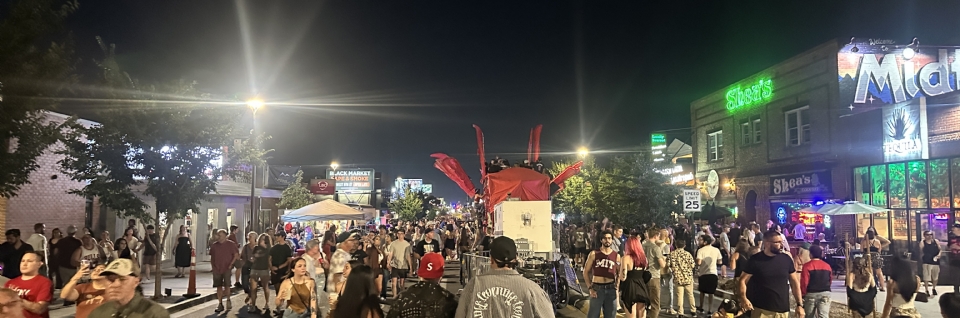
At its latest meeting on July 13, The Redevelopment Agency Advisory Board unanimously found that the Dancing in the Streets Sponsorship Program does not meet the requirements of NRS 279 — the state law that governs what a redevelopment agency is actually allowed to spend tax-increment money on. Nor does it meet the requirements for the redevelopment agency's own District Activation Pilot program. You can watch the discussion yourself on YouTube. It's worth your time if you've ever wondered what "redevelopment" is legally supposed to mean versus what it's become in practice.
Staff actually brought five programs to the board for that meeting, each needing its own findings resolution declaring it compliant with NRS 279 and in furtherance of the Redevelopment Plan: the Activation Program, Dancing in the Streets, ReSecure, Small Walls, and ReStore. Here are my rankings on how each of these fit the legal definition of redevelopment:
B.6 – ReStore Facade and Tenant Improvement — Strongest fit for NRS 279. This is textbook "alteration, improvement, modernization, reconstruction or rehabilitation of existing structures in a redevelopment area" under NRS 279.408(c). Little to question here.
B.4 – ReSecure (safety-focused property improvement) — Strong fit. Physical improvements to property (lighting, security hardware) tie directly to blight elimination — NRS 279.418 specifically declares blighted areas a threat to public health and safety, so a safety/security improvement program has a clean statutory hook.
B.5 – Small Walls (murals/artwork) — Reasonably strong, if the money goes toward physical alterations to walls/structures. Murals on buildings arguably fall under "alteration...of existing structures" (279.408(c)). The question to ask: does funding cover only the physical installation, or also artist stipends, curation, programming? The former is clean; the latter drifts toward the same gray zone as B.2.
B.2 – Activation Program (placemaking that activates public spaces) — I was a bit more iffy on this one - "Activating public spaces" could mean capital work (lighting, seating, plaza infrastructure — clean fit under 279.408) or could mean funding programming/events on that space (weaker fit, resting only on the broad "financial or other assistance...for any of the purposes of this chapter" language in 279.468(3)). The resolution language itself doesn't tell which. To qualify for the District Activation Pilot Program, an event would have to be a multi-day repeating event, per the requirements set forth in that program.
B.3 – Dancing in the Streets Sponsorship — Weakest fit in my opinion. There are fundamental differences between sponsoring/producing weekly events and one-time episodic events. This event did not qualify under the District Pilot Activation Program because it is not a 'new' event, and while it does recur yearly, it also is not a multi-day event. So to find a way around that restriction, the RDA Board directed staff to "find a legal way to make it work" and thus that workaround is the RDA 'sponsoring' the event by getting its logo and brand featured prominnently within the event. I think this is the core issue I have. We are saying "this event doesn't qualify under the District Activation Pilot Program, so let's find a loophole." Sponsoring a recurring event is a step further removed from "redevelopment" as defined than even B.2 — there's no structure, space, or capital improvement being created; it's operational support for a third-party program. The likely rationale will be economic development / foot traffic / blight-area business support tied to the "general welfare" language in 279.408, but that's a broader inferential leap. Also, Dancing in the Street is already receiving $25,000, the same amount as Hot August Nights, a week-long event, from the event room tax fund.
I looked at the other four programs and did not have an issue with those that create physical improvements to buildings. ReStore funds facade and tenant improvements — physical work on buildings. ReSecure funds safety-focused property upgrades — also physical. Small Walls funds murals and artwork installed on walls — again, physical. Even the Activation Program, murkier as it is, at least gestures toward capital investment in public space. Also, weekly events are found to aid redevelopment (see below). One-time episodic events do not.
NRS 279 defines "redevelopment" as the planning, development, redesign, reconstruction, or rehabilitation of a redevelopment area — the actual provision of structures and spaces necessary for the general welfare. The statute even spells out what counts: recreational facilities, the alteration or rehabilitation of existing buildings, improvements to open space. It's a law built around bricks, walls, plazas, and parcels.
Sponsoring a recurring street event doesn't fit that mold. There's no structure being built or rehabilitated, no property being improved. It's operational support for a program somebody else runs. The best legal argument staff could lean on is the catch-all language letting an agency accept and spend money "for any of the purposes of this chapter" — but that's a much thinner reed than "we fixed a building" or "we secured a property." The RAAB agreed that thin reed wasn't enough to hang a finding of compliance on.
I also went and read the Redevelopment Agency's own goals page. The City lists six goals for the Agency — more businesses and services, more housing diversity, better pedestrian and vehicle flow, more outdoor space and public art, more access to natural resources, and historic preservation.
Not one of those six goals mentions events. Not one mentions placemaking, although the new web site for the RDA is placemaking-centric.
(Reno does have a whole Placemaking & Events page under the Redevelopment section — so the City clearly wants to do this kind of work. The question isn't whether Reno should fund events. It's whether the Redevelopment Agency's TIF dollars, bound by a specific 1980s-era state statute, are the right pot of money to do it with.)
One Night Doesn't Build a District
Even setting the legal question aside, there's a practical case against treating a single annual sponsorship as placemaking. The placemaking field has been pretty clear on this for a while: one-off events don't do what recurring ones do.
Strong Towns laid out the logic well in a piece on activating community spaces — the whole point of programming a place isn't the event itself, it's getting people into the habit of showing up. Recurring events build a sustained audience because awareness compounds over time instead of resetting after a single date. And there's a stickiness to it: people form memories and relationships tied to a specific physical place, and those bonds are not something you can recreate somewhere else even with an identical event. A once-a-year sponsorship can't build that kind of routine.
Project for Public Spaces makes essentially the same point in its placemaking framework: regular events build momentum and showcase local talent, but one-off events can't substitute for ongoing programming — at best they're a way to test an idea, not a way to change how people use a place long-term.
RAAB's vote is a recommendation, not a final decision — the actual Redevelopment Agency Board (the Mayor and City Council) will act on it this coming Wednesday.
If the event is becoming so expensive that not even the City of Reno can afford to sponsor it, and instead we look for a loophole to give Redevelopment money to them, then perhaps the event needs to be scaled back. Is it necessary to close the entirety of Virginia Street, which is one of the primary costs of the event? Could business parking lots be used instead? There was a point in time where the MidTown Art Walk actually did not involve street closures, and that was even prior to the sidewalks being widened.
Don't get me wrong, I love Dancing in the Streets, I live two blocks from MidTown's Virginia Street strip, and enjoy the event and neighborhood. But I'd be lying to myself if I considered MidTown 'blighted' at this point, and maybe the event could be produced without requiring three days of over a mile of street closures.
I don't want the Redevelopment Agency to become a bank account to pay for one-time event sponsorships that fall way outside of the scope of redevelopment. One-time episodic events that happen once a year are great photo opps, it allows everyone to say 'See? People do come out' but then when the event is over, the neighborhood goes right back to the same state it was in before...for downtown Reno, after the Western Lights Festival left, the streets were once again empty the day after the event ended. I'm sure it provided an incredible temporary economic boost for all of the MidTown businesses during Dancing in the Streets. But does it result in the long term redevelopment of the neighborhood? Does someone building a new apt building or opening a new restaurant look at a one-time once-a-year event and say to themsleves "Oh yeah I'm definitely going to open up shop because of that one-time event'? I need proof of that.
I think it is entirely appropriate and possible for me to say 'I love Dancing in the Streets, I support it, I attend the event' while also saying 'I don't think the event provides any long term redevelopment benefits'. MidTown was solidifying itself as MidTown long before Dancing in the Streets was a thing. I just feel this is more the wheelhouse of the Event Room Tax Fund, the Downtown Reno Partnership, and the MidTown Merchant's Association.
I also feel the newly rebranded "RE:UP" redevelopment agency would not benefit from the sponsorship of this event. I could be wrong, but I don't feel a prospective developer is going to see the RE:UP logo slapped onto digital posters for Dancing in the Streets and think to themselves 'Wow I had never heard of them before, I should contact them to build a project in an RDA district and increase the property tax base.' Maybe if it was a developer conference full of builders and lenders? Some might accuse me of being short-sighted in that regard, and I might agree if I hadn't run a successful branding and web site agency for 20+ years prior to lending my talents to the government sector.